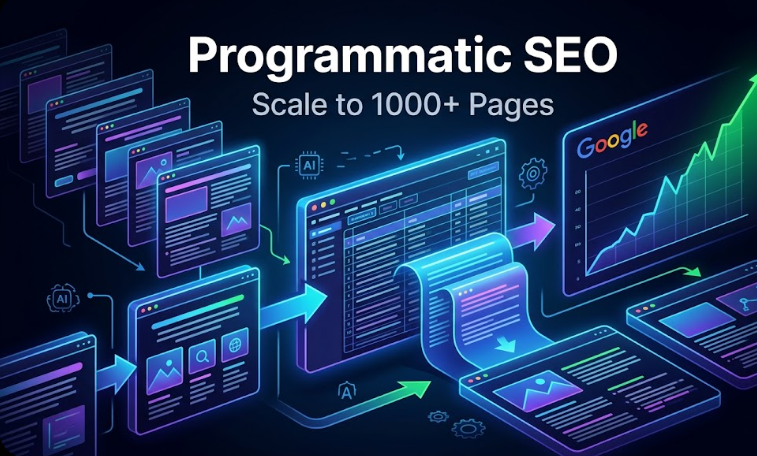
Programmatic SEO Explained: Create 1000 Pages and Rank Faster (2026 Guide)

In 2024, I was manually producing one blog post per day. The physical strain and time investment were substantial, yet traffic remained stagnant. I encountered Srini from Trichy, who operates a nursing job board. He disclosed that his site contained approximately 2,000 pages, of which he had personally authored only two. The remaining content was generated through programmatic SEO.
His Google Search Console displayed 50,000 monthly visits from automatically generated pages. The demonstration altered my understanding of content scalability. This guide consolidates the knowledge I subsequently acquired.
Development expertise is not a prerequisite. A spreadsheet and a WordPress plugin are sufficient initial resources. Google does not penalize this approach when executed correctly—unlike the structural errors that cause most blogs to fail within their first year.
Defining Programmatic SEO
Consider how Zapier generates pages such as "Connect Gmail to Google Sheets," "Connect Gmail to Slack," and "Connect Gmail to Trello." These thousands of pages follow an identical template with a single variable—the second application name.
That is programmatic SEO: the automated generation of hundreds or thousands of landing pages using a template populated by a structured data source, such as a spreadsheet or database.
The methodology is straightforward: instead of manually authoring 1,000 articles, you construct one template, insert variable data points, and produce 1,000 distinct pages within approximately one hour.
This is not a novel or obscure technique. Tripadvisor employs it for every city ("Hotels in Paris," "Hotels in London"). G2 utilizes it for every software category ("Best CRM software," "Best email marketing software"). Amazon applies it to every search filter combination.
In 2026, AI tools enable each generated page to contain genuinely unique content—not merely swapped keywords. This is the critical enhancement.
Why Programmatic SEO Remains Effective in 2026 (India Context)
Three factors contribute to its continued efficacy:
- Long‑tail search volume is increasing: Over 50% of Google queries now contain four or more words. A query such as "best plumber in Velachery for leaking pipes" represents a genuine, specific need. Programmatic SEO systematically captures these hyper‑specific queries, including zero‑search‑volume keywords that often rank rapidly.
- Google's algorithm rewards genuine utility: Pages that provide unique value—beyond superficial text substitution—are indexed and ranked. Many programmatic pages achieve ranking without external backlinks when supported by strong topical authority.
- AI reduces the cost of content uniqueness: Tools like ChatGPT and Claude can generate a unique 200‑word introductory paragraph for each generated page, mitigating concerns regarding "thin content" penalties.
I have observed a job board focused on "delivery jobs in [city]" generate 300 pages and attract 20,000 monthly visitors. The site owner lacked coding knowledge and utilized only Google Sheets and a WordPress plugin.
Replicable Programmatic SEO Patterns
The following patterns have demonstrated consistent effectiveness. They can be adapted to various niches.
- Location‑based service pages: "Plumber in [city]," "Electrician in [locality]," "Best biryani in [area]." Platforms like HomeAdvisor and Thumbtack built substantial businesses on this model.
- Product or tool comparison pages: "Jasper vs Copy.ai," "Jasper vs Writesonic," "Jasper vs ChatGPT." Software review sites generate thousands of these pages automatically.
- Directory or listing pages: "Best coffee shops in [neighborhood]." Data can be sourced from Google Maps or a curated CSV file.
- Instructional variations: "How to write a cover letter for [job role]." The core steps remain consistent while examples vary by role.
- E‑commerce product variant pages: Even small stores can generate pages from a CSV feed for combinations like "Red cotton T‑shirt size M" and "Red cotton T‑shirt size L."
An Indian application: I assisted with the creation of pages for "Best CBSE schools in [Bangalore locality]." Data from 50 localities was used. Each page contained a unique 300‑word introduction referencing local traffic conditions, nearby parks, and parent testimonials. Within three months, 30 of these pages achieved first‑page rankings. The site owner now generates revenue by selling leads to educational institutions.
Step‑by‑Step Implementation (No Coding Required)
The following process was executed without prior development experience.
Step 1: Identify a Keyword Pattern with Minimum 100 Variations
Utilize Google Autocomplete, Ahrefs free tier, or structured brainstorming. Example pattern: "best [product] for [use case]." Compile a comprehensive list of use cases. Alternatively, "plumber in [city]" requires a list of relevant cities.
Action: Create a spreadsheet with columns for each variable (e.g., "city" and "state"). Populate with a minimum of 50 rows.
Step 2: Assemble Structured Data
For location pages, required data may include city name, state, pin code, average service rate, and local contextual tips. For comparison pages, data may include product names, feature lists, and pricing information. Manual entry is feasible for 50–100 rows. For 1,000+ rows, consider utilizing an API (such as Google Places API) or authorized scraping methods.
I began with manual data entry for 50 cities, which required approximately two hours. The investment was justified.
Step 3: Develop a Page Template with Variables
Design a single master page to serve as the blueprint for all generated pages. Insert placeholders using syntax such as {{city}}, {{state}}, or {{average_rate}}. The template should include:
- Title tag: "Best Plumber in {{city}} – Affordable & Reliable"
- H1 heading: "Top Plumbers in {{city}}"
- A unique introductory paragraph (ideally AI‑generated per city)
- A list or table of plumbers populated from the spreadsheet
- An FAQ section (which can be standardized or customized per city)
Step 4: Automate Page Generation (WordPress Method)
For non‑developers, the most accessible method is:
- WordPress + WP All Import + Advanced Custom Fields (ACF): Create a Custom Post Type (e.g., "City Page"). Utilize WP All Import to read the CSV file and generate one post per row. Configure the import to set the post title, slug, and populate custom fields defined by ACF. Then construct a template within your theme that dynamically displays the custom field data.
- Alternative: Webflow + Airtable: Connect an Airtable base to Webflow CMS using Zapier or the native CMS API to bulk‑create pages.
- Static site generators (Next.js, Hugo): Suitable for large‑scale deployments but require some technical familiarity. Building AI workflows without coding can streamline much of this automation.
I employed the WordPress method. After configuring the template and ACF fields, importing 100 rows required approximately five minutes. All pages were published instantly.
Step 5: Ensure Content Uniqueness to Avoid Penalization
This step is critical. Pages that are 90% identical are typically disregarded by Google. Mitigation strategies include:
- Use ChatGPT or Claude to generate a unique 200‑300 word introductory paragraph for each page. I created an "ai_intro" column in my spreadsheet and populated it using manual ChatGPT prompts. For 100 cities, this required approximately 30 minutes.
- Incorporate authentic images or embedded maps (e.g., Google Maps static API for location pages).
- Include user reviews or ratings (even if initially placeholder data, with a plan for future updates).
- Add a "Last updated" timestamp and commit to monthly data refreshes.
I previously generated 200 pages with only substituted city names. Google indexed only 12 of them. The time invested yielded negligible return. This error is not repeated.
Step 6: Implement Systematic Internal Linking
Each generated page should link to:
- A central pillar page that provides overarching context—this is foundational to building an effective content cluster.
- Other programmatically generated pages within the same category (e.g., "Plumber in Chennai" linking to "Plumber in Bangalore").
- The website homepage.
Internal linking can be automated using plugins such as Link Whisper or by incorporating a "related cities" section within the page template that dynamically pulls data from the source spreadsheet.
Recommended Tool Stack
| Tool | Purpose | Cost |
|---|---|---|
| Google Sheets | Initial data storage and management | Free |
| WP All Import (WordPress) | Import CSV data and create posts | $69 one‑time |
| ChatGPT / Claude | Generate unique introductory content | Free tier available |
| Link Whisper | Automated internal linking suggestions | ₹6,500/year |
| Google Search Console | Monitor indexing and impression data | Free |
Total investment for the first campaign was approximately ₹6,000 (plugin cost plus hosting).
Common Implementation Errors
- Insufficient content uniqueness: Generating 200 pages with only swapped location names resulted in minimal indexing. AI‑generated unique introductions are now standard practice.
- Absence of internal linking: Orphan pages underperform. Indexing rates doubled after implementing contextual links.
- Outdated data: Plumber pages containing obsolete contact information generated user complaints. Monthly data refreshes are now scheduled.
- Excessively broad keyword patterns: Attempting "best [anything]" proved unattainable. Narrowing to "best CRM for real estate agents" yielded results.
- Misalignment with search intent: Using a single template for both comparison queries and top‑ten list queries failed. Always analyze the top three ranking pages for the target keyword before finalizing the template structure.
Case Study: Remote Job Board Scaling
A Hyderabad‑based job board specializing in "work from home jobs" implemented programmatic SEO for the following patterns:
- "Work from home jobs in [city]" (50 cities)
- "Work from home [job role] jobs" (30 roles)
- "Work from home jobs for [experience level]" (5 levels)
Total pages generated: 50 × 30 × 5 = 7,500. A static site generator and a CSV file of job listings were utilized. Each page contained a unique introduction discussing that city's internet infrastructure, available coworking spaces, and remote work culture.
Outcome after six months: 30,000 monthly visits, with 80% originating from Google. The site now sells premium job postings to companies, generating approximately ₹1.5 lakh in monthly revenue. This outcome exemplifies how small businesses use strategic automation to compete with larger companies.
Programmatic SEO vs. Traditional SEO
These approaches are complementary, not mutually exclusive.
- Traditional SEO (in‑depth guides, narrative content): Appropriate for high‑value, competitive topics requiring deep expertise, storytelling, and backlink acquisition. Example: "How to start a blog in 2026."
- Programmatic SEO: Appropriate for long‑tail, low‑competition, high‑volume patterns. Example: "Best blog niche for [specific demographic]."
Successful websites employ both methodologies. Traditional content establishes authority, while programmatic pages capture extensive long‑tail traffic. For those interested in full automation, hidden AI tools can manage significant portions of this process.
Conclusion
Programmatic SEO is not a shortcut to guaranteed traffic. It is a structured automation methodology. In 2026, with the availability of AI and no‑code tools, it is accessible to individuals without programming backgrounds. The optimal outcome is achieved when AI efficiency is combined with human strategic oversight.
AI is also reshaping career opportunities for those who learn to build and scale digital assets.
Select a keyword pattern within your niche that offers a minimum of 50 variations. Create a spreadsheet. Utilize WordPress and WP All Import to generate an initial test batch of 10 pages. Monitor Google Search Console for two weeks. If impressions are recorded, scale the operation to 500 or more pages.
My own traffic increased from 2,000 monthly visitors to 15,000 within eight months, driven primarily by programmatically generated pages. The methodology is replicable.
— T Charles Philip, Chennai
Frequently Asked Questions
1. Does Google permit programmatic SEO?
Yes, provided the pages offer genuine value and avoid substantial duplication. Google's guidelines emphasize user value. Incorporating unique AI‑generated or user‑contributed content ensures compliance. Many prominent websites utilize this approach.
2. What is a recommended starting page volume?
Begin with 50–100 pages. Monitor indexing and engagement metrics for two to three months. If performance is satisfactory, proceed to scale to 1,000 or more pages.
3. Are backlinks required for programmatic pages to rank?
Not necessarily. Internal links from authoritative pages on the same domain (such as the homepage or pillar pages) are often sufficient, particularly for low‑competition long‑tail queries. A limited number of external backlinks to category‑level pages can facilitate link equity distribution.
4. Can AI be used to generate unique content for each page?
Yes. Tools like ChatGPT or Claude can be prompted with variables from the data set. For example, for "Plumber in Chennai," a prompt such as "Write a 200‑word introduction discussing plumbing challenges specific to Chennai (hard water, older apartment infrastructure, monsoon season impacts)" produces effective, contextually relevant content.
5. What is the most frequent error made by beginners?
Generating thousands of pages without ensuring sufficient content uniqueness. The result is a large volume of near‑identical pages that Google disregards. Prioritize content quality and uniqueness over raw page count. Start with a controlled test, validate the approach, and then scale.
6. Is programmatic SEO feasible without technical skills?
Yes. The combination of WordPress, WP All Import, and a spreadsheet requires no coding knowledge. If you can manage an Excel file and install a plugin, you possess the necessary skills to implement programmatic SEO.
Related Articles
All articles →
Google AdSense Approval in India: Why You Got Rejected and Exactly How to Fix It (2026 Guide)
Getting rejected by Google AdSense in India? Here are the real reasons and step-by-step fixes. Practical checklist for Indian bloggers…

Instagram Marketing for Indian Clothing Boutiques: Get Daily Orders Without Paid Ads (2026 Guide)
How Indian boutique owners use Instagram Reels, Stories, and DMs to get daily orders without spending on ads. Real strategies…
WhatsApp Business Marketing for Indian Shop Owners: Get More Orders Every Day (2026 Guide)
Learn how Indian shop owners use WhatsApp Business to send offers, take orders, and build customer loyalty — completely free.…