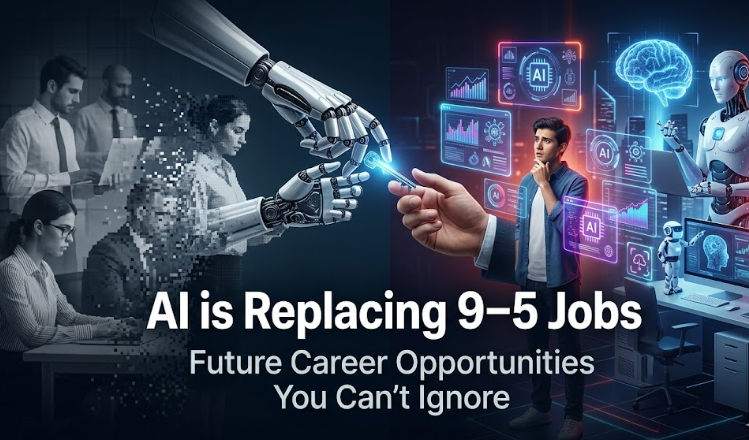
AI Job Loss in India 2026: Real Talk for Worried Professionals

Chennai, April 2026
You've asked for an honest assessment of AI's impact on jobs—not the polished LinkedIn narrative, nor the panic circulating on WhatsApp. This is the perspective of someone who has spent years inside hiring and career consulting.
I recruited professionals for six years across engineering, operations, and finance. I then shifted to career consulting. Before that, I worked at a startup that no longer exists. That experience gave me a front-row seat to how hiring actually works—and how it's changing.
Most commentary on AI and employment swings between unwarranted optimism and paralyzing fear. Neither extreme is helpful. Here is what I'm actually observing.
A Moment the Abstract Became Concrete
In late 2024, I visited a friend named Tanvir in Bangalore. He manages operations for an e‑commerce company selling home goods—around 200 employees, nothing glamorous.
His four‑person customer support team was overwhelmed. The issue wasn't slow response; it was sheer volume.
We spent an afternoon configuring an off‑the‑shelf AI triage tool. Within a week, two people were handling the same workload. The other two focused exclusively on the 25% of tickets the AI couldn't confidently resolve.
No one was terminated immediately. But when one team member left five months later for a better commute, the position was never backfilled. The other reassigned employee remains in an adjacent role.
Tanvir was relieved about his operational metrics but clearly uncomfortable with the broader implications. He said, "I'm not proud of this, but I don't see what alternative I had."
That's the reality. Not a sudden robot takeover, but hundreds of small operational decisions that gradually reshape the workforce.
Which Jobs Face Genuine Risk? (An Unfiltered Assessment)
If your work primarily involves performing similar tasks faster and more consistently, you should be paying attention. The economic logic for automation in these areas is compelling.
High-exposure roles include:
- Junior analysts producing the same reports with different date ranges
- Content writers generating dozens of similar product descriptions daily
- Customer support representatives handling a limited set of recurring queries
- Entry‑level data entry and basic accounting clerk positions
A contact in Hyderabad—let's call her Sana—worked as a junior social media writer at a marketing agency. Over fourteen months, her team shrank from eight junior writers to two. The remaining two now primarily manage AI tools and perform final editing.
Sana kept her position not because she wrote better copy than the AI (she admits it writes cleaner product descriptions). She stayed because she understood client brand voices intimately and could identify when the AI output was subtly wrong.
This aligns with what I explored in my piece on AI vs human creativity—the human role shifts from production to direction and quality control.
The Pipeline Problem No One Discusses
Senior accountants, paralegals, and QA leads are currently safe. The concern is the pipeline.
Companies historically hired multiple juniors for each senior, building a talent bench over time. That ratio is collapsing. In five to ten years, the supply of experienced seniors may shrink because fewer people progressed through the entry‑level stage.
I don't have a clean solution for this structural issue. It deserves more attention than it receives.
If you're a small business owner, the same forces threatening jobs also create opportunity. I've detailed how small businesses are using AI to compete with larger companies—the tools that displace tasks can also level the playing field.
Where Are the New Opportunities? (Realistic Assessment)
Yes, new roles are emerging. But we must be honest about accessibility.
High‑skill technical roles:
- Machine learning engineers and AI engineers who build and deploy models
- Require deep Python proficiency, statistics knowledge, and system architecture understanding
- Not a three‑month pivot unless you already have a technical foundation
- Worth the multi‑year investment if you're early in your career
Accessible non‑technical roles:
- Prompt engineering and AI content strategy
- Tools consulting—helping businesses identify and implement the right solutions
- Compensation in India ranges from ₹60 lakhs to over ₹1 crore for experienced practitioners
- No coding required, but the market is becoming crowded quickly
What consistently works? Having a tangible project to demonstrate.
I've observed candidates get hired based on a single concrete project—"I built a content workflow for a restaurant in Pune, here's what changed"—while others with longer resumes received no response. One verifiable outcome often outweighs multiple certificates.
Freelance automation consulting is underrated. Small businesses everywhere recognize they should leverage AI but lack internal expertise. If you can walk in and set up functional workflows, project fees of ₹2.5 lakhs to ₹10 lakhs are realistic.
I've written a comprehensive guide on building AI workflows without coding. If you can navigate drag‑and‑drop interfaces, you can build this skillset.
For those considering a larger venture, explore hidden AI tools that can automate entire business operations. Some are remarkably capable.
Contextualizing the "97 Million New Jobs" Projection
The World Economic Forum projects 97 million new jobs by 2030. McKinsey offers similar forecasts. Historically, technology has generated more employment than it has eliminated—in aggregate, over sufficient time horizons.
However, "net positive in aggregate" offers little comfort to an individual whose job disappears next month in a region where new opportunities aren't materializing.
Both extreme positions—complacent optimism and nihilistic despair—fail to capture the messy reality. I'm skeptical of anyone who expresses excessive certainty about either outcome.
"Just learn AI skills" is valid individual advice. It is also an incomplete societal response. Both statements can be true simultaneously.
Practical Guidance for Concerned Professionals
1. Leverage Your Existing Domain Knowledge
Don't abandon your field prematurely. Your industry expertise is more valuable than you realize when combined with AI tool fluency.
A marketer who understands marketing and AI tools is far more valuable than someone who knows the tools deeply but is learning marketing from scratch. The same applies to finance, operations, legal, and other domains.
2. Stop Consuming Tutorials. Start Building.
I spent months in early 2024 watching instructional videos and feeling productive. Looking back, I had built nothing tangible. The breakthrough came when I applied the tools to a real proposal I genuinely needed to complete.
Find an actual problem that frustrates you and solve it with AI. Not a tutorial exercise. A real issue with real stakes.
3. Skills Worth Developing
- No‑code automation (Make.com, Zapier, n8n): Faster learning curve than most assume; consistently underrated
- Python: Valuable if you're willing to commit months, not weeks
- Critical evaluation of AI output: The ability to detect errors and subtle inaccuracies is a genuine differentiator
One observation: people who constantly post about "learning AI" on social media often have less to demonstrate six months later than those who quietly build something and then surface with results. If you must choose, prioritize building.
If you're considering a solo venture, review my analysis of the one‑person business model—the current tool landscape makes it more viable than ever.
Two Real‑World Trajectories (Not Polished Success Stories)
Damien, Mumbai
Mid‑forties. Two decades in HR management. When his company implemented a new HR system, data migration became his responsibility by default—no one else would handle it.
He spent months learning automation tools, not out of career ambition, but necessity. He built workflows his team relied on.
A year later, his division was restructured and he was laid off. But he now had concrete examples to discuss in every conversation. He's currently an independent HR systems consultant, earning comparable income with fewer hours.
He's also candid about the eighteen months between layoff and steady clients: they were the most stressful of his career. Freelancing is not a frictionless path.
A Former Client, Delhi
Junior copywriter at an agency. As her team contracted, she struggled for months to find another writing position.
She eventually repositioned herself as someone who could manage AI‑generated content—editing, maintaining brand voice, and catching hallucinations. She accepted a pay cut to secure a role that specifically required this hybrid skillset.
Within a year, she was earning more than before. But she acknowledges the pay cut period was psychologically difficult—harder than she admitted at the time. The outcome was positive. The journey was not linear.
If you're weighing different monetization paths, my comparison of digital products vs services may help clarify your options.
Frequently Asked Questions
Is it too late to start developing AI‑relevant skills?
No. Those who feel they've missed the opportunity are often the ones who spent two years reading about AI without taking action. Someone who begins today and builds a concrete project within six months is still early. The window is narrowing, but it remains open.
What if I have no technical background whatsoever?
Focus on non‑technical roles: prompt engineering, AI content work, tools consulting. Your domain knowledge is your primary asset—you understand what is useful versus what is nonsense. The non‑technical path is more competitive than a year ago, but remains viable with demonstrable work.
Will AI replace humans entirely?
I cannot answer this with confidence, and I distrust those who can. My assessment: complete replacement is unlikely, but the economy a decade from now will differ substantially from today. The transition period is the unresolved challenge.
Which roles are already being displaced in India?
Primarily repetition‑based work: entry‑level data entry, basic customer support, junior content writing, and some accounting assistant positions. Safer roles are those where the work varies sufficiently that a comprehensive rulebook cannot be written. This definition is imperfect but directionally accurate.
Conclusion: The Only Advice That Matters
Select one tool. Use it this week for something you genuinely need to accomplish—not a tutorial exercise. Observe what happens.
If you want to stay ahead in the AI‑driven job market, start building practical skills today. The professionals who thrive will not be those who consumed the most content about AI, but those who integrated it into their actual work. The sooner you adapt, the stronger your position will be in the future.
— T Charles Philip
Related Articles
All articles →
How Small Businesses Use AI to Compete with Big Companies (2026 Guide)
Practical AI strategies for Indian small businesses to level the playing field against larger competitors. Real tools, costs in INR,…

AI vs Human Creativity: Who Wins in the Next Decade? (2026 Guide)
Explore the real strengths and limits of AI creativity vs human ingenuity. Includes practical workflows, legal insights for Indian creators,…
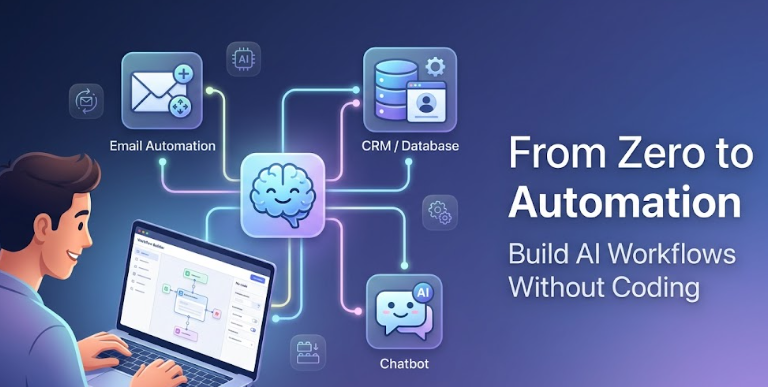
Build AI Workflows Without Coding: A 2026 Guide for Indian Businesses
Learn to automate repetitive tasks using no-code AI tools like Zapier and ChatGPT. Practical steps, real costs in INR, and…