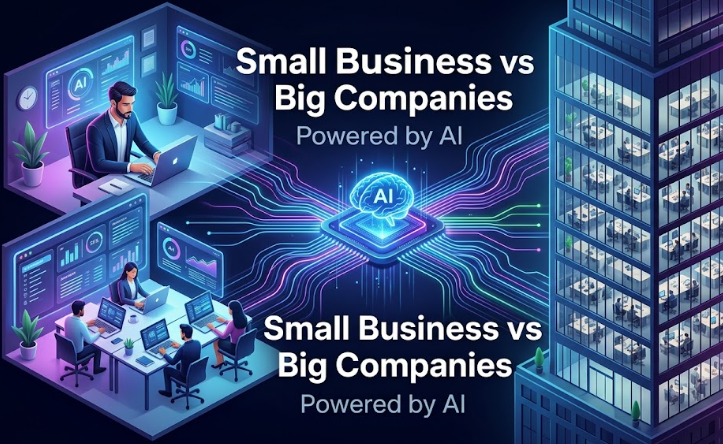
How Small Businesses Use AI to Compete with Big Companies (2026 Guide)

Two years ago, I regarded AI as another technology trend reserved for large corporations with substantial budgets. I operate a small digital marketing agency in Chennai—myself and two freelancers—and we were struggling to meet client demands, manage social media schedules, and respond to endless status inquiries.
I made a costly miscalculation: I ignored AI for too long. A competitor with significantly less experience began leveraging AI for small businesses and secured clients I could not even obtain meetings with. That experience clarified that the competitive landscape had fundamentally shifted.
This guide provides concrete information on how small businesses use AI in India—which tools generated measurable time savings, which proved financially wasteful, and the actual investment required (substantially less than typical monthly food delivery expenses).
The Structural Disadvantage Small Businesses Face
Consider the resources available to a large corporation:
- Marketing budget of ₹50 lakh per month
- Dedicated customer support team of ten individuals
- Data scientists predicting consumer purchasing behavior
A small business owner typically has themselves, perhaps part‑time assistance from a relative, and a spreadsheet that is no longer fit for purpose.
This was my situation in 2024. I spent approximately three hours daily answering identical questions: "What are your rates?" "Do you provide SEO services?" "Can I see your portfolio?" The time required to actually develop the business was minimal.
I subsequently discovered AI tools for small business—not enterprise‑grade systems, but straightforward, affordable solutions accessible to a solo founder in Chennai or a retail shop owner in Pune.
Within three months, repetitive tasks were reduced by approximately 60%. I no longer answered the same questions manually. I no longer wrote every social media post from scratch. And I began to focus on genuine business development.
Implementation Errors to Avoid
My initial AI experiment was a notable failure. I subscribed to an "AI business assistant" that claimed comprehensive automation capabilities. The annual cost was ₹8,000. Within one week, the following occurred:
- An incorrect invoice was sent to a client (an extra zero was added—the client assumed it was a joke)
- A social media post was published to Instagram at 3 AM
- A "client meeting" was scheduled that turned out to be a spam call
I deactivated the tool and absorbed the financial loss.
Lesson: Avoid all‑in‑one "magic" solutions. Begin with free versions of individual tools. Never automate customer‑facing communications without a human review step.
Another misstep: attempting to replace my human content writer with ChatGPT. The calculation seemed straightforward—why pay ₹15,000 monthly when AI could perform the task for free?
The outcome was a decline in blog traffic from 2,000 monthly visitors to 800. The AI‑generated articles were generic. They lacked my distinctive voice, local references (Bangalore traffic, Chennai rains, Delhi winters), and the inside jokes that resonated with readers. The audience detected the difference.
I re‑engaged the writer. AI is now used for first drafts and outlines, while the writer contributes the distinctive voice and cultural nuance. This hybrid approach delivers optimal results. I've explored this balance further in my analysis of AI vs human creativity.
AI Tools I Evaluated and Discontinued
Several widely promoted tools did not justify their cost or complexity for my use case:
- Jasper.ai – At $49/month (≈₹4,100), the expense is difficult to justify when ChatGPT's free tier provides approximately 80% of the functionality. Only viable for high‑volume content production.
- AI phone call tools – Attempted a service that claimed to answer customer calls. It consistently failed to understand basic Hindi and Tamil mixed with English. Functionally unusable.
- Automated LinkedIn outreach bots – Resulted in a temporary account suspension. LinkedIn actively detects and penalizes automation. Semi‑automated tools with human review are the safer approach.
- AI bookkeeping tools – QuickBooks AI miscategorized half of my expenses. "Zomato" was labeled "Office Supplies" rather than "Meals & Entertainment." Manual correction eliminated any time savings.
AI is not a replacement for human judgment. It is a tool to amplify it.
Practical AI Applications for Indian Small Businesses
Based on my experience and conversations with other small business owners in Chennai, Bangalore, and Mumbai, these are the areas where AI delivers measurable value.
🔹 Marketing and Content Creation
I use ChatGPT (free tier) to generate 20 headline variations for each blog post. Approximately 18 are unusable, two are viable, and occasionally one triggers a superior original idea. For social media, Typefully (₹1,600/month) enables drafting a week's worth of tweets in roughly 30 minutes.
India‑specific recommendation: Train the AI on your existing content. I provided ChatGPT with my previous 10 blog posts and requested it to emulate my writing style. The output is not perfect, but it approximates my tone more closely.
🔹 Customer Support Automation
I implemented Chatling (free tier, then ₹1,600/month) on my website. It fields recurring questions such as "What are your rates?" "Do you serve clients outside Chennai?" and "What is your typical turnaround time?" It now manages approximately 40% of support inquiries without intervention. I only engage with complex questions.
Measured outcome: Response time decreased from four hours to approximately two minutes. Client satisfaction improved. My sleep quality improved correspondingly.
🔹 Lead Generation Efficiency
I tested Instantly.ai (₹3,100/month) for cold email outreach. The platform warms up email domains (reducing spam classification) and personalizes emails using AI. I sent 500 emails over one month. The results: 15 replies, three meetings, and one client engagement valued at ₹50,000. The tool's cost was recovered from the first transaction.
Critical note: Avoid appearing spammy. I invested approximately 10 minutes per email adding personalized details. This contributed significantly to the outcome.
🔹 Workflow and Operations
Zapier (free tier) has transformed my operational efficiency. I configured a workflow: new lead completes a Google Form → automatically added to my Google Sheets CRM → receives a personalized welcome email from Gmail. I no longer intervene in this process. It recovers approximately two hours weekly. For those new to automation, my guide on building AI workflows without coding provides a structured introduction.
🔹 Finance and Analytics
Polymer Search (₹2,500/month) processes my unstructured expense spreadsheet and automatically generates visualizations. I can query "show me my largest expenses last month" and receive an immediate response. No pivot table construction required.
Realistic Cost Assessment (Indian Rupees)
Substantial capital is not required to begin. Here is an accurate cost breakdown:
- Free tier (sufficient for 1–2 months of evaluation): ₹0. ChatGPT free, Canva free, Zapier free (100 tasks/month), Chatling free tier. Adequate for a micro‑business.
- Solo freelancer / very small business: ChatGPT Plus ₹1,700 + Chatling ₹1,600 + Zapier Starter ₹1,700 = ₹5,000/month + GST ≈ ₹5,900. This is less than the value of one small client project.
- Small agency (3–5 people): Add Instantly.ai ₹3,100 + Polymer ₹2,500 = total approximately ₹11,500/month. Still less than one full‑time employee's monthly salary (₹20,000–30,000).
From my experience, most Indian small businesses can capture 80% of the benefits with a monthly investment of ₹2,000–3,000—the cost of two family dinners at a restaurant.
Regarding free tools: They exist and are useful for testing. However, free tiers impose limits. ChatGPT free is slower and less reliable during peak usage. Zapier free provides only 100 tasks per month—sufficient for testing, but if you generate 20 leads daily, the limit will be reached within five days. Be prepared to upgrade when you scale.
Recommended Starter AI Stack for Indian Small Businesses (2026)
If I were beginning today with current knowledge, this is the configuration I would deploy:
- Writing and brainstorming: ChatGPT (free, then ₹1,700 for Plus)
- Social media scheduling: Typefully (₹1,600) or Buffer free tier
- Customer support chatbot: Chatling (free tier, then ₹1,600)
- Cross‑application automation: Zapier (free tier, then ₹1,700)
- Basic design tasks: Canva (free, AI features included)
Total monthly cost after free trials: ₹6,600 + GST ≈ ₹7,800. This is less than my previous monthly expenditure on coffee and takeout.
With this stack, you can automate lead capture, provide 24/7 customer inquiry responses, schedule social media content, and generate content ideas. It will not operate your entire business, but it will recover 10–15 hours weekly. Those hours accumulate significantly over time. For additional tool recommendations, refer to my guide on hidden AI tools for business automation.
Is AI Automation Worthwhile for Indian Small Businesses?
The answer depends on task selection.
Worthwhile applications:
- Repetitive customer inquiries (pricing, hours, policies)
- Social media captions for routine posts
- First drafts of emails, blog posts, or proposals
- Data transfer between applications (Google Forms → Sheets → CRM)
Not worthwhile applications:
- High‑stakes legal or financial documents (AI errors carry significant consequences)
- Building deep client relationships (people prefer human interaction)
- Creative work requiring your unique voice (use AI as an assistant, not a replacement)
- Any context where a mistake could result in client loss or legal exposure
An important nuance specific to India: labor costs are lower than in Western markets. In the US, hiring a virtual assistant costs $15–20/hour. In India, a freelancer can be engaged for ₹300–500/hour. The cost differential between AI and human labor is smaller here. Consequently, AI's primary value in India is not dramatic cost reduction—it is speed and 24/7 availability. You cannot contact your freelancer at 2 AM. Your AI chatbot remains operational.
Additionally, Indian consumers expect rapid responses. If you operate an e‑commerce store in Delhi and a customer in Kolkata inquires about a product at 11 PM, they will not wait until morning. They will purchase from a competitor who responds. AI provides that competitive edge.
Case Study: Chennai Bakery Competing with National Chains
A client—"Sweet Rise Bakery" in Chennai—operates a single retail location managed by a husband‑and‑wife team. They were losing market share to national chains with loyalty applications and substantial advertising budgets.
We implemented the following AI‑assisted solutions:
- ChatGPT to generate daily Instagram captions incorporating local Chennai references
- Canva AI to produce professional‑quality product photography (replacing blurry mobile phone images)
- Chatling chatbot on their website to address inquiries regarding delivery radius and eggless cake availability
Outcome after four months: Online orders increased 120%. Cost per lead on Facebook advertisements decreased 60% because AI‑generated ad creatives performed more effectively. The owner stated: "I feel like I finally have a marketing team—but I'm paying less than my electricity bill."
This demonstrates the potential of AI for small businesses when implemented thoughtfully.
Common Mistakes Small Business Owners Make with AI
- Purchasing too many tools simultaneously: This leads to overwhelm and abandonment. Master one tool before adding another.
- Failing to train the AI: ChatGPT without context produces generic responses. Provide it with your past emails, brand voice guidelines, and FAQs. It learns from the input.
- Automating without a contingency plan: What occurs if the AI tool experiences downtime? Maintain a manual backup process. I once experienced a six‑hour Zapier outage and reverted to manual data entry.
- Neglecting data privacy: Do not upload customer phone numbers, addresses, or payment details to free AI tools. Use enterprise‑grade tiers or anonymize data.
- Expecting flawless performance: AI will make errors. Review critical outputs. My personal rule: if the output reaches a paying customer, a human reviews it first.
Five‑Step Implementation Plan
Avoid overcomplication. Follow this straightforward process:
- Identify a single repetitive task. Which daily activity feels as though a robot should perform it? For me, it was responding to "what is your pricing?" inquiries.
- Select a free AI tool for that specific task. For pricing inquiries, I used Chatling's free tier.
- Complete setup in one afternoon. Most tools provide templates. I had Chatling operational in 45 minutes.
- Test for one week. Monitor what the AI handles correctly and where it fails. Adjust settings or prompts accordingly.
- If time savings are realized, upgrade to a paid plan. If not, test an alternative tool. Rapid failure is preferable to prolonged investment in an ineffective solution.
Do not attempt to automate your entire business within a week. That path leads to burnout and wasted resources.
Future Trajectory of AI for Small Businesses in India (2026–2030)
Based on observable trends:
- Hindi and regional language AI capabilities will expand significantly. ChatGPT already handles Hinglish reasonably well. Full support for Tamil, Telugu, and Marathi is expected soon. This represents a transformative development for local businesses.
- Voice AI for customer support will become more prevalent. The ability for customers to call a small business and have an AI handle the inquiry in Hindi is approaching.
- AI‑powered UPI and payment reminders will emerge. Tools that automatically remind customers to complete payments via WhatsApp with an embedded payment link are already in beta and functioning.
- "One‑person unicorns" will become more common. Solo entrepreneurs leveraging AI to operate what appears to be a 20‑person company. This is already occurring in Bangalore's startup ecosystem. This aligns with broader shifts I've discussed in how AI is reshaping careers in 2026.
Small businesses that disregard AI will face increasing competitive pressure—not because AI is magical, but because their competitors will be faster, more cost‑efficient, and perpetually available.
Conclusion
AI will not resolve every operational challenge. A quality product, competent customer service, and fundamental marketing acumen remain essential. However, if you are investing hours in repetitive tasks—answering identical questions, composing similar emails, publishing routine social media content—AI can return those hours to you.
In a small business, time is a direct financial variable.
Begin with a single free tool this week. ChatGPT is the most accessible starting point. Use it to draft your next email newsletter or generate 10 Instagram captions. Assess the experience. If you recover 30 minutes, that constitutes a victory. Then proceed to the next tool. Gradually, you will assemble a functional AI stack that works for you—and you will question why you delayed implementation.
— T Charles Philip, Chennai
Frequently Asked Questions
1. Is AI financially accessible for a very small business (annual revenue under ₹10 lakh)?
Yes. Most AI tools provide free tiers. ChatGPT free alone can manage writing, brainstorming, and basic analysis. Even paid tools begin at ₹1,600–2,000/month—less than the cost of one client lunch meeting. I started with ₹0 expenditure and only upgraded after confirming results.
2. Are technical skills required to utilize AI tools as a small business owner?
No. If you can send an email or post on Instagram, you can use ChatGPT. Most tools operate via plain English prompts. Automation platforms like Zapier may require one to two hours of tutorial viewing, but they remain no‑code. I am not technically trained—I learned through practical application.
3. Which AI tool should a small business owner in India try first?
Begin with ChatGPT (free). Use it for drafting client emails, generating social media captions, brainstorming blog topics, or creating a draft of your "About Us" page. It is the most versatile AI tool available. Once comfortable, explore Chatling for customer support or Zapier for workflow automation.
4. Can AI replace my employees?
AI replaces tasks, not people. For instance, instead of hiring a full‑time social media manager, you might use AI to draft posts and have a freelancer review and publish them. I have not terminated any employees due to AI—I have simply stopped hiring for repetitive roles.
5. How do I ensure an AI tool handles customer data safely?
Never upload customer phone numbers, addresses, or payment details to free AI tools. For sensitive data, use paid plans that guarantee data privacy (e.g., ChatGPT Team plan, Zapier paid tiers). Anonymize data where possible—use "Customer A spent amount X" rather than actual identifiers. For most small businesses, basic caution is sufficient.
6. Do AI tools function effectively with Indian languages such as Hindi or Tamil?
ChatGPT and Gemini handle Hinglish (Hindi + English) reasonably well. Pure Tamil or Telugu performance is improving but not yet perfect. For customer support in regional languages, human involvement may still be necessary. Significant improvements are anticipated in 2026–2027.
7. How much time can realistically be recovered with AI?
Based on my experience, 5–15 hours weekly, depending on business type. A freelancer drafting proposals might recover 5 hours. An e‑commerce store answering customer inquiries might recover 15 hours. The most significant gains come from automating the tasks you find most tedious—then the time savings feel even more substantial.
Related Articles
All articles →
AI vs Human Creativity: Who Wins in the Next Decade? (2026 Guide)
Explore the real strengths and limits of AI creativity vs human ingenuity. Includes practical workflows, legal insights for Indian creators,…
Build AI Workflows Without Coding: A 2026 Guide for Indian Businesses
Learn to automate repetitive tasks using no-code AI tools like Zapier and ChatGPT. Practical steps, real costs in INR, and…
Hidden AI Tools for Business Automation in India (2026 Guide)
Discover underrated AI automation tools that save time and money for Indian freelancers, small businesses, and agencies. Honest reviews with…