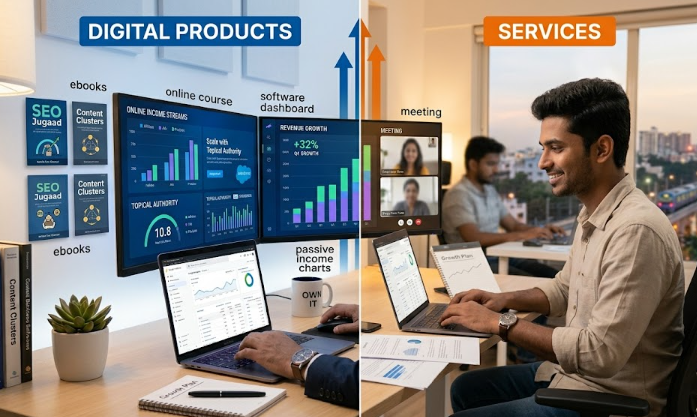
Digital Products vs Services: Which Is More Profitable in 2026?

I have operated both business models. I began as a freelance service provider—offering writing, SEO consulting, and website maintenance. I subsequently transitioned to digital products—templates, ebooks, and courses. Both models are capable of generating revenue, but they represent fundamentally different operational frameworks. One model led to exhaustion. The other provided autonomy.
There is no universally "correct" choice. The optimal selection depends on individual temperament, financial circumstances, and tolerance for delayed gratification. After four years of operating both models within the Indian market, I can provide a detailed analysis of the trade‑offs, realistic earning potential, and the model I would select if initiating operations today.
This guide provides actual revenue figures (in rupees), documentation of hidden costs, an assessment of the associated mental load, and a framework for determining which model aligns with different personality profiles. No exaggerated claims—only a candid comparison derived from direct operational experience.
Defining Digital Products and Services
Digital products are assets created once and sold repeatedly. Examples include Notion templates, Canva templates, ebooks, online courses, Lightroom presets, spreadsheet tools, website themes, stock photography, music loops, and software applications.
The creation effort is incurred once. Each subsequent sale generates revenue minus payment processing fees and marketing expenditure. No incremental effort is required per customer.
Services involve exchanging time and expertise for client compensation. Examples include freelance writing, web design, SEO consulting, social media management, video editing, virtual assistance, coaching, accounting, and legal advisory services.
Hours are directly traded for rupees. Increased client volume necessitates increased work hours. A definitive ceiling exists: there are only 24 hours in a day.
Both models can be profitable, but the nature of that profitability differs substantially.
Implementation Errors to Avoid with Both Models
I initiated operations with services under the assumption that premium rates would permit reduced working hours. In theory, this is viable. In practice, I found myself continuously pursuing new clients, managing scope modifications, and allocating more time to proposals and meetings than to billable work. I achieved ₹1.5 lakhs in monthly revenue but was operating at full capacity with no leverage. Every rupee originated from direct personal effort.
I subsequently experimented with digital products. My first product was a simple Notion project management template requiring six hours to construct. I priced it at ₹500. In the initial month, 12 copies were sold—₹6,000 for six hours of work. Acceptable, but not transformative.
Error: I anticipated digital products would generate "passive income" immediately. They do not. Consistent marketing is required, particularly during the launch phase. My template generated zero sales for two months until I developed traffic acquisition capabilities. Targeting zero‑search‑volume keywords was instrumental in securing initial traffic.
An additional error involved underpricing services. As an Indian freelancer, I charged ₹5,000 for a website audit requiring four hours—an effective rate of ₹1,250 per hour. However, I failed to account for non‑billable time: proposal development, revision cycles, and client communication. The effective hourly rate was closer to ₹600. The same audit should have been priced at ₹15,000 or higher. Undervaluation of expertise is a common and costly mistake.
The primary lesson is that both models require active marketing. Neither is a "set and forget" proposition. However, one model scales far more efficiently once distribution channels are established.
Comparative Financial Analysis (Indian Rupees)
The following figures are based on my direct experience and documented outcomes from other solopreneurs operating in India.
Services Model (Freelance / Consulting)
- Typical monthly revenue (solo operator): ₹50,000 – ₹3,00,000
- Profit margin: 60–80% (after taxes, software subscriptions, payment fees)
- Time investment: 30–60 hours weekly
- Scaling limitation: Available hours or the requirement to hire (which reduces profit margin)
- Recurring revenue potential: High (through retainer arrangements), though client attrition is a factor
- Startup cost: Minimal—a laptop and existing skills
- Time to first income: Days to weeks
Digital Products Model
- Typical monthly revenue (solo operator): ₹10,000 – ₹2,00,000 (wide variance)
- Profit margin: 70–90% (after platform fees and marketing costs)
- Time investment: High initial creation effort, low ongoing maintenance (5–15 hours weekly)
- Scaling limitation: Market size and distribution reach—no theoretical upper bound
- Recurring revenue potential: Moderate (each sale is one‑time unless a subscription model is employed)
- Startup cost: ₹0–₹10,000 (tools, hosting)
- Time to first income: Weeks to months (typically longer than services)
Profitability assessment: Over an extended timeframe, digital products demonstrate superior profit potential per hour of effort. A service provider generating ₹1.5 lakhs monthly while working 40 hours achieves an effective rate of approximately ₹938 per hour. A digital product creator who develops a single ₹1,000 template that sells 500 copies over one year generates ₹5 lakhs for perhaps 20 hours of total effort (including marketing). That represents an effective rate of ₹25,000 per hour.
However—and this qualification is significant—most digital products fail to achieve meaningful sales volume. The majority sell fewer than 50 copies. Services provide consistent, predictable income. Digital products involve greater uncertainty unless supported by an established audience or effective marketing infrastructure.
Services funded my operational expenses while I developed the product business. Products now account for 80% of total income. This transition required approximately two years of service work to facilitate.
Hidden Costs Frequently Overlooked
Hidden Costs of Services
- Non‑billable time: Proposal development, discovery calls, revision cycles, invoicing, and follow‑up communications can consume 30–40% of working hours.
- Client acquisition expense: Without relying on platforms like Upwork (which impose fees), continuous marketing effort is required. One unproductive month directly impacts income.
- Scope expansion: Client requests for "minor adjustments" that require substantial additional time. The choice is between absorbing the cost or potentially damaging the relationship.
- Tax compliance complexity: Service income above ₹20 lakhs requires GST registration, invoice issuance, expense tracking, and regular filing obligations.
- Mental load: Managing multiple clients, deadlines, feedback cycles, and payment schedules is cognitively demanding. Work‑related thoughts frequently intrude into non‑working hours.
Hidden Costs of Digital Products
- Marketing expenditure: The "build it and they will come" assumption is invalid. Content development, SEO optimization, advertising, or audience building requires time or financial resources.
- Platform fees: Gumroad charges 10% plus a fixed fee. Etsy imposes listing and transaction fees. Shopify involves recurring monthly costs.
- Customer support: Even with a well‑designed product, users have questions, encounter technical issues, or request refunds. This constitutes unpaid time.
- Updates and maintenance: Software evolves. Templates become outdated. Products require periodic updates.
- Piracy exposure: Digital assets can be copied and distributed without authorization. Some customers will share purchased files, resulting in lost sales.
Neither model constitutes effortless income. Both require sustained effort, though the nature of that effort differs substantially.
Decision Framework: Which Model Aligns with Your Profile?
Consider the following questions:
Is consistent, immediate income a necessity? If yes, initiate operations with services. Acquiring paying clients is faster (within days or weeks). A product business can be developed concurrently as a secondary income stream.
Do you find client management aversive? If discovery calls, scope modifications, and payment collection are sources of significant stress, digital products may be more suitable. Interaction with customers is less personal and more scalable.
Do you possess an existing audience? An email subscriber list, social media following, or blog readership substantially facilitates digital product sales. Without an established audience, services may present a lower initial barrier because clients can be sourced through platforms like Upwork, Fiverr, or LinkedIn.
Do you derive greater satisfaction from creation or execution? Services emphasize "doing"—executing tasks for clients. Digital products emphasize "creating"—constructing an asset once. Which activity generates more sustained energy?
What is your tolerance for income variability? Services typically provide predictable income. Digital product revenue is variable—months with zero revenue may be followed by a month generating ₹1 lakh. Can you manage that degree of uncertainty?
Based on my observations, the majority of successful solopreneurs in India commence with services and subsequently transition to products. Service income funds operational expenses during the product development phase. Once product revenue reaches a sustainable threshold, services can be reduced or eliminated. This was my precise trajectory and aligns with the one‑person business model framework.
Case Studies: Indian Solopreneurs Who Succeeded with Each Model
Services success: A Bangalore‑based SEO consultant serves small e‑commerce brands, charging ₹50,000 per month per client with a roster of six clients. Monthly revenue is ₹3 lakhs, with net profit approximating ₹2.4 lakhs after taxes and expenses. She works approximately 45 hours weekly, values client interaction, and appreciates the variety. An attempt to create an online course was unsuccessful due to a lack of enthusiasm for the required marketing activities. Services are an ideal fit for her profile.
Digital products success: A Pune‑based designer creates Instagram‑oriented Canva templates and sells them on Gumroad and Etsy. Average selling price is ₹800, with monthly volume of approximately 300 units. Monthly revenue is ₹2.4 lakhs, with net profit approximating ₹2 lakhs after platform fees. She works roughly 20 hours weekly—developing new templates, updating existing assets, and performing essential marketing tasks. She prioritizes autonomy and strongly dislikes client communications. Digital products are an ideal fit.
Hybrid success: A Mumbai‑based career coach conducts individual coaching sessions (services) at ₹10,000 per session while also offering a self‑paced online course (digital product) priced at ₹15,000. The course generates approximately ₹1 lakh monthly in passive revenue, while coaching contributes an additional ₹2 lakhs monthly. Coaching clients frequently purchase the course as well. Each model complements and reinforces the other.
All three approaches are demonstrably profitable. No single model is objectively superior—the optimal choice is a function of personal fit.
Implementation Path: Services
- Identify one specific service in which you possess demonstrable competence. Target "SEO audit for Shopify stores in India" rather than the broader category of "digital marketing." Specificity enhances differentiation.
- Establish fixed package pricing. Avoid hourly billing where feasible. Offer a defined scope for a predetermined fee (e.g., "Website speed optimization package: ₹15,000 inclusive of audit, implementation, and one month of support").
- Develop a concise portfolio or case study. Showcase prior work, including pro bono projects or work performed for acquaintances. Before‑and‑after metrics are compelling.
- Source clients where they naturally congregate. LinkedIn, Upwork, Fiverr, niche Facebook groups, and relevant subreddits are effective channels. Solicit referrals from former colleagues and personal contacts.
- Deliver exemplary work and request testimonials. A single satisfied client can generate multiple referrals through word‑of‑mouth.
Services represent the most expedient path to generating initial online revenue. Use this income to accumulate savings and develop confidence.
Implementation Path: Digital Products
- Identify a specific problem solvable with a digital asset. Example: "Freelancers struggle to produce professional proposals efficiently." Solution: A proposal template.
- Develop a minimal viable product. Do not attempt to construct a 50‑page ebook initially. Build a 5‑page checklist or a basic template. Launch rapidly.
- Select a distribution platform. Gumroad is the most accessible for beginners (free to start, manages payments and delivery). Etsy is suitable for visual products. Alternatives include Payhip, Sellfy, or Shopify.
- Set a reasonable initial price. Range: ₹300–₹1,500. A lower price facilitates the first sale, which validates the underlying concept.
- Drive targeted traffic. Publish blog content addressing questions relevant to the product. Distribute content through social media channels. Contribute to relevant online communities. Building topical authority around the niche is essential for long‑term organic discovery.
- Iterate based on customer feedback. Enhance the product, incorporate additional value, and adjust pricing upward as justified.
Anticipate a gradual initial trajectory of three to six months. Most product businesses require time to accumulate momentum. Premature discontinuation is a frequent cause of failure. AI tools can accelerate certain aspects of product creation and content development.
The Hybrid Approach: Mitigating Risk
Operating both models concurrently is feasible and often advisable. The recommended progression is as follows:
- Commence with services to generate immediate income and accumulate audience insights. Every client interaction reveals genuine problems, which subsequently inform product development opportunities.
- While maintaining service obligations, develop one digital product as a parallel initiative. Leverage service experience to identify a product addressing a recurring client challenge.
- Introduce the product to existing service clients and professional network. Offer introductory discounts. Solicit testimonials.
- Once product revenue achieves consistency, reduce service hours incrementally. Retain a limited number of preferred clients if the engagement remains fulfilling.
- Reinvest product revenue into marketing initiatives (advertising, enhanced tools, selective outsourcing) to facilitate further growth.
This hybrid strategy reduces overall risk. A decline in product sales is buffered by ongoing service income. The loss of a service client is offset by continued product revenue. Diversification is prudent. I employed this precise strategy. Services funded living expenses for 18 months while the product portfolio was developed. Products now constitute 80% of income, but select consulting engagements are maintained for the interpersonal connection they provide.
Realistic Earning Potential in India (2026)
Services only (freelance / consulting):
- Beginner: ₹20,000–₹50,000 monthly
- Intermediate: ₹50,000–₹1,50,000 monthly
- Advanced: ₹1,50,000–₹5,00,000 monthly (typically accompanied by 50+ weekly hours)
- Top tier (agency operators, not solo): ₹5,00,000+ but with team overhead
Digital products only:
- Beginner (initial product, no audience): ₹0–₹10,000 monthly (for several months)
- Intermediate (one validated product, modest traffic): ₹10,000–₹1,00,000 monthly
- Advanced (multiple products, established audience): ₹1,00,000–₹5,00,000 monthly
- Top tier (viral product, substantial audience): ₹5,00,000–₹20,00,000+ monthly (rare but documented)
Hybrid (services plus products):
- Most stable trajectory: ₹50,000–₹2,00,000 monthly combined
- Lower risk profile, higher reported satisfaction
These figures represent revenue. Profit margins are consistently higher for products (80%+) than for services (60–70% after accounting for non‑billable time). My current income composition is approximately ₹2.5 lakhs monthly from products and ₹50,000 from occasional consulting, with a weekly time commitment of 25–30 hours.
Common Misconceptions
Misconception 1: "Digital products are fully passive."
Inaccurate. They require marketing, updates, and customer support. However, they are demonstrably more passive than services. An extended absence from work still permits revenue generation—a scenario not feasible with client‑based services.
Misconception 2: "Services scale easily."
Inaccurate. Scaling services typically necessitates hiring, which introduces management complexity and reduces profit margins. Most solo service providers encounter a practical ceiling of ₹3–5 lakhs monthly while operating independently.
Misconception 3: "Design expertise is required to sell digital products."
Inaccurate. Templates, ebooks, spreadsheets, checklists, and Notion dashboards require minimal or no design proficiency. Platforms like Canva or pre‑built themes are sufficient. Functionality generally supersedes aesthetic appeal.
Misconception 4: "Clients are easier to find than product buyers."
Inaccurate. Both require active, deliberate marketing. On platforms like Upwork, you compete with thousands of freelancers. With products, you compete in search results. Neither is "easy." However, products possess the advantage that once ranking on Google or an email list is established, traffic becomes semi‑automated. Programmatic SEO techniques can facilitate product discovery.
Misconception 5: "An audience is a prerequisite for selling digital products."
Inaccurate. An audience is highly beneficial, but sales can also be generated through marketplaces such as Etsy, Gumroad Discover, or Creative Market. These platforms provide built‑in traffic in exchange for higher transaction fees.
Conclusion
Over an extended timeframe, digital products exhibit superior profit potential per hour of effort invested. A successful product can generate revenue during periods of rest, travel, or while developing additional products. Services are constrained by a definitive ceiling: available time.
However—and this distinction is critical—the majority of digital products fail to achieve meaningful sales volume. Most sell fewer than 50 copies. Services, assuming basic competence, will almost always generate some level of income. Services represent lower risk with a lower ceiling. Products represent higher risk with a higher ceiling.
For approximately 90% of beginners, the recommended approach is to initiate with services to establish cash flow and foundational skills, then develop products as a parallel initiative. Service income can fund product creation and initial marketing efforts. Once product revenue approaches or exceeds service income, a deliberate decision can be made regarding the optimal long‑term mix.
Individuals with existing savings and the capacity to endure 6–12 months of minimal income may elect to pursue products directly. This path involves greater stress, and many abandon the effort prior to achieving the first sale.
Irrespective of the chosen model, both require active self‑promotion. Both require providing genuine value to others. Both can support a fulfilling lifestyle. The "correct" choice is the one that aligns with individual temperament and financial circumstances.
This week, determine which model you will pursue initially. If services, identify one prospective client and dispatch a proposal. If products, create a minimal version of one digital asset and list it on Gumroad. Execution supersedes perfection.
— T Charles Philip, Chennai
Frequently Asked Questions
1. Which model is optimal for an individual with no existing marketable skills?
If you currently lack marketable skills, begin by acquiring a service skill (e.g., Canva design, foundational writing, virtual assistance). You can receive compensation while learning. Subsequently, leverage that skill to create a digital product (e.g., a Canva template collection, an ebook on freelancing). Services provide direct insight into what customers are willing to compensate for. Products then scale that acquired knowledge.
2. Is GST registration required to sell digital products in India?
If you sell through platforms like Gumroad, they manage GST for digital products sold to Indian customers (collection and remittance). Independent GST registration is not required until annual revenue exceeds ₹20 lakhs or if you operate through your own website. For services, GST registration is mandatory above ₹20 lakhs annual revenue. Consult a qualified chartered accountant for situation‑specific guidance.
3. Which model requires lower initial capital?
Both can be initiated with negligible financial investment. Services require a laptop and internet connectivity. Digital products require the same plus potentially a modest expenditure for tools (Canva Pro subscription, Gumroad fees). Neither necessitates substantial upfront capital. The primary investment is time and learning.
4. How should pricing be determined for services or products in India?
For services, research the rates charged by peers with comparable experience. Set an initial rate that feels moderately uncomfortable (slightly high). Reduction is always possible. For products, price based on delivered value rather than creation effort. A template that saves an individual ten hours is reasonably priced at ₹1,000, even if it required only two hours to construct. Test different price points. My first product was initially priced at ₹300 and subsequently increased to ₹800 following validation.
5. Can both models be operated concurrently without burnout?
Yes, but prioritize services initially. Once two to three regular clients are established (consuming 10–20 hours weekly), allocate remaining time to developing a single product. Avoid attempting to build a product portfolio while simultaneously managing ten service clients. That trajectory leads to burnout. Gradual, consistent progress is more sustainable. I operated in hybrid mode for two years before products became the dominant income source.
6. What is the most profitable digital product category in India currently?
Based on observable trends: Notion templates (productivity, academic, business applications), Canva templates (social media, presentations, resumes), ebooks addressing niche topics (examination preparation, career development, hobby instruction), and spreadsheet templates (budgeting, inventory management, project tracking). Specificity is the primary determinant of success. "Budget tracker for Indian freelancers" will outperform a generic "budget template."
7. How do I secure my first service client or product buyer?
For services: Upwork, Fiverr, LinkedIn, Facebook groups, Reddit (r/forhire, r/India), and personal referrals. Offer an introductory discount for initial clients in exchange for testimonials. For products: Gumroad Discover, Etsy, Reddit (r/DigitalProducts), Pinterest, and content creation that addresses questions directly relevant to the product. Targeting zero‑search‑volume keywords is an effective strategy for securing initial organic traffic.
Related Articles
All articles →
Freelance Digital Marketing in India: Start with Zero Experience and Earn ₹30,000/Month (2026 Guide)
Beginner\'s guide to freelance digital marketing in India. Which skills to learn, where to find clients, and how to earn…

From Visitor to Customer: Complete Funnel Strategy for Beginners (2026)
Learn to build a simple marketing funnel that converts strangers into loyal customers. Step‑by‑step plan, real Indian examples, and low‑cost…

The Psychology Behind High‑Converting Websites: Proven Strategies (2026)
Learn psychological principles that turn visitors into customers. Step‑by‑step optimization plan, real Indian examples, and actionable tips for solopreneurs.