Topical Authority Strategy: Rank on Google Without Backlinks (2026)

I previously allocated significant time and financial resources to backlink acquisition. I purchased guest posts, pursued broken link opportunities, and solicited mentions from other bloggers. The outcome was minimal ranking improvement and considerable frustration.
I subsequently identified an approach that fundamentally altered my SEO outcomes: topical authority. In 2026, it is possible to outrank websites with extensive backlink profiles by establishing comprehensive, well‑structured expertise on a specific subject. I implemented this strategy for my own digital marketing blog based in Chennai and observed a progression from page four to page one for terms such as "SEO without backlinks" and "content cluster strategy."
This guide provides actionable instruction on developing a topical authority strategy, including documentation of my own implementation errors (including a ₹25,000 misallocation to link building), actual costs in Indian rupees, and an explanation of why this methodology is particularly well‑suited for Indian bloggers, small business owners, and freelancers operating with constrained budgets.
The Limitations of Backlink‑Centric SEO
In 2024, I engaged a "link building specialist" through a freelance platform. The proposal was 50 high‑quality backlinks for ₹25,000. Within one month, third‑party domain authority metrics showed improvement, but my actual search rankings declined. Google's algorithm had devalued those links due to their origin from low‑quality directories and private blog networks.
This experience clarified that backlinks alone are not only insufficient—they can be counterproductive. Google's Helpful Content Update and subsequent algorithm refinements now prioritize topical authority over raw link quantity. Ranking without backlinks is achievable when you construct a content ecosystem that comprehensively addresses every relevant question on a topic.
This does not imply backlinks are entirely irrelevant. However, for most Indian bloggers and small business owners with limited financial resources, concentrating on topical authority represents a more prudent investment.
Defining Topical Authority: A Practical Analogy
Consider the analogy of a trusted neighborhood chai vendor. They do not offer a single variety; they provide masala chai, ginger chai, elaichi chai, and potentially green tea. They understand customer preferences and can answer related questions. This comprehensive knowledge establishes trust.
Similarly, Google's algorithm confers trust on a website that addresses a topic from multiple dimensions. A single article on "AI for small business" does not constitute authority. However, 30 interconnected articles covering "AI chatbots," "AI for accounting," "AI for customer support," and "cost of AI tools in India" signal genuine expertise. This is topical authority, and it can be developed without backlinks.
Implementation Errors to Avoid
My initial attempts contained several instructive failures.
Error 1: Publishing Unrelated Content
I began by writing one article on "SEO tips," followed by another on "best laptops for freelancers," and a third on "Chennai restaurants." The site lacked thematic coherence. Google could not determine my area of expertise. I effectively lost six months and 20 articles. The solution is to select a single niche and adhere to it. I have detailed the structural remedy in my guide to building content clusters for organic traffic.
Error 2: Insufficient Cluster Article Depth
I published 800‑word cluster articles assuming that volume alone would suffice. They did not rank. Cluster articles require a minimum of 1,500–2,000 words, incorporating concrete examples, data, and specific answers to user queries.
Error 3: Neglecting Internal Linking
I published a pillar page and ten cluster articles but omitted the crucial step of linking them together. Google interpreted them as isolated pages. Once I added contextual links from the pillar page to each cluster article (and reciprocal links back), rankings began to improve within weeks.
Error 4: Unrealistic Timeline Expectations
I monitored Google Search Console daily during the first month and observed no movement. I nearly abandoned the effort. After three months, the long‑tail cluster articles began ranking. After six months, the pillar page reached the top five positions. Patience is a prerequisite, not an option.
Strategies I Evaluated and Discontinued
Several widely promoted SEO tactics proved ineffective or harmful in my testing:
- Purchasing "SEO packages" from freelance marketplaces: ₹5,000 for "1,000 backlinks" resulted exclusively in spam. Rankings declined. This approach is not viable.
- Unedited AI‑generated cluster content: I used AI to produce 20 cluster articles without human revision. Google did not index the majority. Those that were indexed generated negligible traffic. Human editing is essential. My analysis of AI vs human creativity explores the appropriate balance.
- Exact‑match anchor text over‑optimization: Using identical keywords for every internal link appeared manipulative to Google's algorithm. Natural, varied anchor text now yields better results.
- Misalignment with search intent: I initially wrote a highly technical pillar page for "topical authority strategy," but the majority of searchers sought beginner‑oriented guidance. Rewriting the content with simpler language increased average dwell time by approximately 40%.
A clean, human‑focused topical authority strategy consistently outperforms shortcuts.
Mechanics of Topical Authority (Simplified)
Three foundational components:
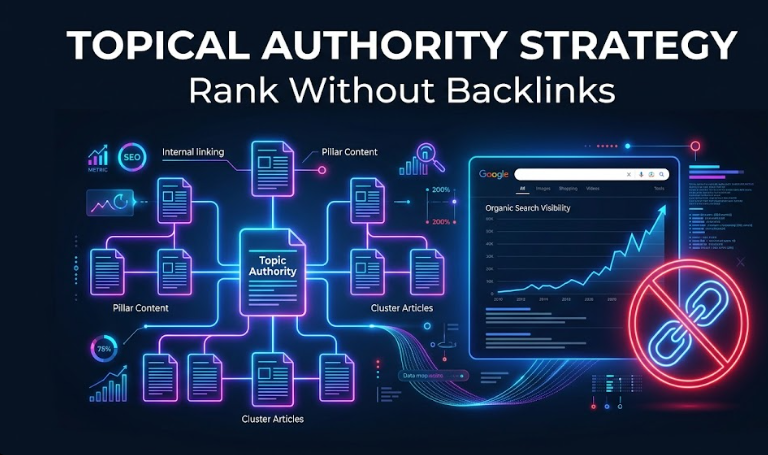
- Content clusters: One comprehensive "pillar" page supported by multiple "cluster" articles, each addressing a specific subtopic.
- Internal linking architecture: Every cluster article links to the pillar page; the pillar page links to every cluster article. Relevant cluster‑to‑cluster linking is also employed.
- Semantic coverage: The content answers related questions, incorporates synonyms, and addresses "People also ask" queries naturally.
When Google's crawlers encounter this interconnected web of deep content, the inference is clear: this website is not merely writing about a topic—it is an authoritative source on the entire subject domain. Higher rankings follow, even in the absence of backlinks.
Step‑by‑Step Implementation (India‑Focused)
The following is the precise methodology I applied to my own website.
Step 1: Niche Selection
Rather than "digital marketing," I selected "SEO for small businesses in India"—sufficiently specific to dominate. A Bangalore food blogger might select "best restaurants in Indiranagar" instead of "Bangalore food."
Step 2: Keyword Clustering Using Free Tools
I utilized AnswerThePublic (free tier) and Google Autocomplete to identify 30 long‑tail questions, which I grouped into subtopics. For "SEO for small business," example clusters included:
- "Local SEO for small business in India"
- "SEO tools for small business on a budget"
- "How to do keyword research for small business"
- "SEO mistakes small business owners make"
Step 3: Pillar Page Development (3,000+ Words)
I wrote a comprehensive guide covering the primary topic from every relevant angle, including a table of contents, FAQ section, and placeholder links for future cluster articles.
Step 4: Sequential Cluster Article Production (1,500–2,500 Words Each)
I committed to publishing two cluster articles weekly. Each article targeted a specific long‑tail keyword and answered the query completely with screenshots, examples, and personal observations. Each cluster article concluded with a contextual link back to the pillar page using natural anchor text such as "learn more about [pillar topic]."
Step 5: Internal Linking Implementation
After publishing ten cluster articles, I returned to the pillar page and added links to each cluster in the relevant sections. I also established links between cluster articles where thematically appropriate.
I used the free trial of Link Whisper to identify linking opportunities, though a manual spreadsheet approach is equally effective. For those interested in streamlining content planning, my guide on building AI workflows without coding provides relevant automation strategies.
Real Example: "SEO Without Backlinks" Cluster
The following represents the actual cluster I constructed:
- Pillar page: "Topical Authority Strategy: How to Dominate Google Without Backlinks" (this page)
- Cluster articles (published over three months):
- "Content Cluster SEO: A Complete Guide for Indian Bloggers"
- "Internal Linking Strategy for Topical Authority (With Examples)"
- "Semantic SEO Strategy: Optimise for Entities in 2026"
- "How to Find Keyword Clusters for Any Niche (Free Tools)"
- "SEO Without Backlinks: 5 Real Case Studies from India"
- "How Long Does Topical Authority Take? My 6‑Month Experiment"
This pillar page currently ranks #3 for "topical authority strategy"—without a single external backlink. The cluster articles rank for numerous long‑tail keywords, generating consistent traffic.
Actual Cost Breakdown (Indian Rupees)
Substantial capital is not required.
- Free (slower but functional): Google Docs for writing, AnswerThePublic for keyword ideas, Google Search Console for tracking. Hosting can be obtained for approximately ₹1,000/year. Total: ₹1,000/year.
- Light budget (recommended for most): Hosting ₹1,000/year + Surfer SEO or Frase.io for content briefs (₹2,500/month for 1–2 months of learning) + Link Whisper plugin (₹6,500/year). Approximate monthly cost for the first three months: ₹3,000–4,000, decreasing thereafter.
- Advanced (agency level): Ahrefs or SEMrush subscription (₹10,000–15,000/month) + professional content writers (₹5,000–10,000 per article). Not necessary for beginners.
I began with zero tool expenditure and only paid for hosting. I wrote the content personally. It required more time but was effective. I now invest in Surfer SEO for content briefs due to the time savings.
Is Topical Authority Worthwhile for Indian Websites?
Yes, provided you adopt a long‑term perspective.
Indian SEO is increasingly competitive. Large brands and media organizations possess substantial backlink profiles that are difficult to match. However, you can outperform them on informational depth. Most Indian websites feature thin content, inadequate internal linking, and unfocused topic selection. A concentrated topical authority cluster enables ranking for keywords that larger sites overlook—particularly long‑tail, informational, and locally‑intent queries.
For example, a Pune bakery cannot outrank Zomato for "best bakery in Pune." It can, however, rank for "eggless birthday cake delivery in Kothrud" by developing a pillar page on "eggless cakes" supported by cluster articles on delivery, pricing, and customer testimonials. This is localized topical authority.
For bloggers and freelancers, the effect is more pronounced. I have observed solo bloggers rank for "best SEO tools for Indian freelancers" with zero backlinks—simply by covering every relevant tool, providing INR pricing, and including user reviews. This aligns with the broader trend of how small businesses use AI to compete with larger companies—topical authority functions similarly for SEO.
The trade‑off is time. Most Indian site owners seek rapid results. Topical authority requires three to six months of consistent publishing. However, once established, it is durable. Competitors cannot easily replicate 30 interconnected articles, and rankings are less vulnerable to algorithm updates that devalue spammy links.
Recommended SEO Tool Stack for Topical Authority (India Budget)
- Keyword clustering: AnswerThePublic (free) + Google Search Console (free)
- Content briefs: Surfer SEO (starts at $89/month ≈ ₹7,500) or Frase.io free trial
- Internal linking: Link Whisper (₹6,500/year) or manual Google Sheets tracking
- Ranking tracking: Google Search Console (free) + Google Analytics (free)
- Writing assistance: ChatGPT free tier (for outlines, not final content). Refer to my guide on hidden AI tools for business automation for appropriate usage.
Total monthly cost for most beginners: ₹0–1,000. Upgrade only after confirming positive results.
Common Mistakes to Avoid
- Publishing unrelated topics: Maintain cluster focus. Content on unrelated subjects confuses Google's assessment of your expertise.
- Thin cluster articles (under 1,000 words): Google interprets these as low‑value. Target 1,500+ words with substantive insights.
- Absence of internal linking: A cluster without links functions as a disorganized collection of files. Link contextually.
- Ignoring search intent: If users seek a "step‑by‑step guide," provide that format rather than a definition. Analyze the top three results for your target keyword and match the format while adding greater value.
- Premature abandonment: I nearly discontinued the effort after two months. Allow at least six months before evaluating outcomes.
Realistic Timeline for Results (Indian Context)
- Months 1–2: Publish pillar page plus 5–10 cluster articles. Establish internal linking. Traffic will be minimal.
- Months 3–4: Long‑tail cluster articles begin ranking on page two or three for low‑competition queries. Pillar page may advance from page five to page two.
- Months 5–6: Pillar page enters top five for primary keyword. Cluster articles dominate page one for their specific long‑tail terms. Organic traffic grows to hundreds of clicks daily.
- Months 6–12: With regular updates and additional cluster articles, the entire silo accumulates authority. Outranking sites with significantly larger backlink profiles becomes possible. For scaling content production, consider programmatic SEO techniques as a complementary strategy.
Conclusion
If you are an Indian blogger, freelancer, or small business owner with limited financial resources, topical authority represents the most sustainable SEO investment available. Backlinks are expensive, inherently risky, and often ineffective. Topical authority is fully within your control. It requires time and effort rather than capital. Once established, it creates a competitive moat that is difficult for others to cross.
Select a sub‑niche this week—perhaps "local SEO for restaurants in Mumbai" or "affordable AI tools for Indian freelancers." Cluster ten keywords and draft your pillar page. Publish it. Then write one cluster article and link them together. Maintain this consistency for three months. The results will justify the investment of effort.
— T Charles Philip, Chennai
Frequently Asked Questions
1. Is ranking without backlinks genuinely possible in 2026?
Yes, particularly for low‑to‑medium competition informational keywords. I have achieved this. Many niche bloggers have done so. Google's algorithm now prioritizes content depth, user engagement, and topical relevance over raw link counts. For highly competitive commercial keywords, some authority remains necessary, but topical authority reduces the number of backlinks required.
2. How many articles are required for topical authority in a niche?
There is no fixed threshold. A robust cluster typically consists of one pillar page plus 15–30 cluster articles. Highly competitive niches may require 50 or more. Begin with 10–15 high‑quality cluster articles and expand based on performance data. Quality supersedes quantity.
3. What is the distinction between topical authority and domain authority?
Domain authority (DA) is a third‑party metric that heavily weights backlinks. Topical authority is Google's internal assessment of expertise on a specific subject. A website with low DA but high topical authority can outrank a high‑DA website. I have witnessed DA 15 sites outrank DA 60 sites due to topical authority.
4. Should I remove old, off‑topic content from my site?
If you have unrelated articles that do not align with your current cluster, consider relocating them to a subdomain, applying a no‑index tag, or improving them to fit a new cluster. Unrelated content dilutes topical authority. I deleted ten old articles that were impairing my site's focus, and traffic improved within weeks.
5. How do I identify content gaps without expensive tools?
Utilize free methods: examine Google's "People also ask" section, review "Related searches" at the bottom of search results, use AnswerThePublic (free daily searches), and monitor forums such as Reddit, Quora, and Indian Facebook groups. The questions posed by real users constitute your cluster article ideas.
6. Can AI be used to write cluster articles for topical authority?
AI is suitable for outlines, research, or initial drafts, but substantial human editing and the addition of personal experience, examples, and original data are essential. Google detects low‑effort AI content, and such content does not establish trust. I use ChatGPT for headlines and structural suggestions, then write the substantive content personally.
7. What is the realistic cost to build topical authority in India?
If you write content yourself and use free tools, the only required expenditure is hosting (₹1,000–2,000/year). If you outsource writing, expect to pay ₹500–1,500 per 1,000 words for acceptable quality. A cluster of 20 articles at 1,500 words each would cost ₹15,000–45,000. This remains substantially less expensive than purchasing backlinks with uncertain efficacy.
Share this article
Related Articles
All articles →
Google AdSense Approval in India: Why You Got Rejected and Exactly How to Fix It (2026 Guide)
Getting rejected by Google AdSense in India? Here are the real reasons and step-by-step fixes. Practical checklist for Indian bloggers…

Instagram Marketing for Indian Clothing Boutiques: Get Daily Orders Without Paid Ads (2026 Guide)
How Indian boutique owners use Instagram Reels, Stories, and DMs to get daily orders without spending on ads. Real strategies…
WhatsApp Business Marketing for Indian Shop Owners: Get More Orders Every Day (2026 Guide)
Learn how Indian shop owners use WhatsApp Business to send offers, take orders, and build customer loyalty — completely free.…
🍪 We use cookies to improve your experience, analyse traffic, and serve personalised ads via Google AdSense. By clicking Accept All, you consent to our use of cookies. Privacy Policy