How to Build a Content Cluster for Unlimited Organic Traffic (2026 Guide)

For approximately two years, my approach to blogging followed a familiar but ineffective pattern. I would identify a keyword, publish a 1,500‑word article, and then shift to an unrelated topic the following week. The content was disconnected, and traffic remained stagnant. I reached a clear ceiling with no indication of further growth.
I experimented with longer articles and even purchased inexpensive backlinks from freelance platforms. None of these tactics produced sustainable results. During a conversation with a fellow blogger who had achieved significant traffic with a niche recipe site, I was introduced to the concept of content cluster SEO.
Within four months of implementing this structured approach, my traffic tripled. No new backlinks were acquired. The improvement resulted entirely from a more intelligent content architecture.
This guide provides a realistic framework for building a content cluster—no exaggerated claims of tenfold growth in ten days. I will outline the precise process, the errors I made, the actual costs in Indian rupees, and why this methodology is particularly effective for Indian bloggers and small business owners.
The Problem with Isolated Content Production
My previous workflow consisted of selecting a keyword daily without strategic consideration. One week I published an article on "best SEO tools." The following week, the topic shifted to "how to start freelancing." The result was a collection of unrelated pages competing against each other for search visibility.
Google Search Console confirmed the issue. Individual articles hovered on page two or three. User behavior metrics were equally concerning—bounce rates exceeded 80%, as visitors arriving for one topic found no reason to explore further.
I was constructing individual pages, not a coherent information ecosystem. The distinction is critical.
Defining Content Clusters
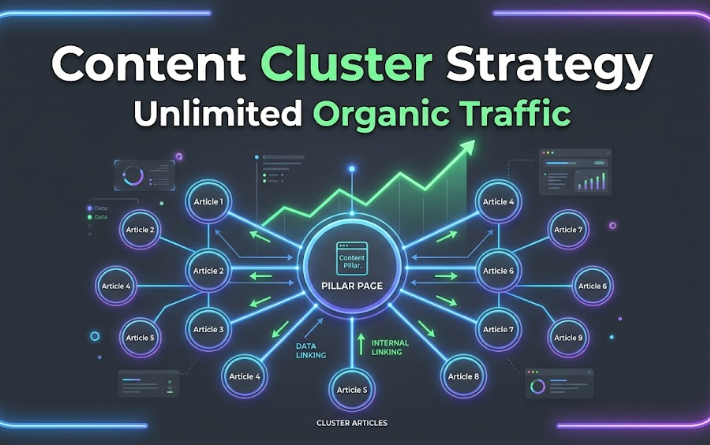
A content cluster consists of two components:
- Pillar page: A comprehensive guide covering a broad topic at a high level. This page provides an overview and links to more detailed resources.
- Cluster articles: Individual posts that address specific questions within the broader topic. Each cluster article links back to the pillar page, and relevant cluster articles link to one another.
Consider a tea stall in Mumbai. The main counter offers the complete selection—ginger tea, cardamom tea, masala tea. Each individual cup represents a cluster article. The stall functions as the pillar. All components are connected, and the establishment is recognized as a comprehensive source.
Google's algorithm interprets this interconnected structure as a signal of topical authority. The site is not merely writing about a subject; it has demonstrated comprehensive expertise. This is the foundational principle of topical authority strategy.
A significant advantage is that internal links perform much of the authority transfer typically associated with external backlinks.
Why Content Clusters Remain Effective in 2026 (India Context)
Google's algorithm has evolved beyond simple keyword matching. It now evaluates entities—topics, concepts, and relationships. A website that addresses a subject comprehensively, with intelligent internal linking, receives trust signals even with a limited backlink profile.
In the Indian digital landscape, this presents a specific opportunity. Large media organizations possess high domain authority but often produce shallow content on niche topics. A focused, in‑depth content cluster can outrank them for long‑tail, specific queries. I have observed this occur with a Pune‑based blog on "Indian Stock Market for Beginners" that outperformed major financial portals for numerous long‑tail terms.
Additionally, the proliferation of affordable mobile data has increased the volume of hyper‑specific searches, often in Hinglish. A query like "how to remove paan stain from white shirt" may register as a zero‑search‑volume keyword, yet it generates actual searches. A content cluster centered on "stain removal for Indian clothing" would effectively capture this demand.
Content clusters function effectively in 2026, and their efficacy is amplified by current search behavior trends.
My Initial Implementation Failure and Corrected Process
My first attempt at building a cluster failed due to poor scope definition. I selected "digital marketing" as the pillar topic—a domain far too broad. I produced a 2,000‑word pillar page of insufficient depth and attempted to write 30 cluster articles simultaneously. I exhausted my capacity within two weeks, and none of the content achieved meaningful rankings.
The corrected process follows.
Step 1: Select a Specific Niche
Avoid broad categories like "fitness." Target a specific segment such as "home workouts for working mothers in Mumbai." This guide's pillar topic is "content cluster SEO for Indian bloggers"—sufficiently narrow to be attainable.
Step 2: Identify One Pillar Keyword and 20–30 Cluster Keywords
I utilize free resources: Google Autocomplete, "People Also Ask" boxes, and Reddit discussions. Entering the core topic into Google and appending letters (e.g., "content cluster a") reveals numerous specific queries. An hour of research typically yields 30+ viable cluster topics.
For this cluster, supporting topics include: "what is a content cluster," "pillar page example," "internal linking strategy for clusters," and "topical authority SEO."
Step 3: Develop the Pillar Page (4,000–6,000 Words)
The pillar page must be comprehensive. Cover each subtopic at a high level without exhaustive detail—that is the function of the cluster articles. At the conclusion of each section, include a contextual link to the corresponding cluster article (e.g., "For a detailed discussion of [specific topic], refer to [cluster article]").
This pillar page required approximately three days to draft. The investment was substantial, but the page now ranks prominently for its target term.
Step 4: Produce Cluster Articles Sequentially
Each cluster article targets one specific long‑tail keyword and should be 1,500–2,500 words in length. Answer the question completely with examples, screenshots, and personal observations. At the beginning or conclusion of each cluster article, include a link back to the pillar page. When thematically appropriate, link between cluster articles as well.
I published the initial five cluster articles over a two‑week period, then added additional articles incrementally. A measured, consistent pace is more sustainable than a rapid, unsustainable burst.
Step 5: Implement Rigorous Internal Linking
Internal linking is the mechanism that transforms a collection of pages into a cluster. Without links, the structure is merely a disorganized folder. My linking rules are as follows:
- Every cluster article links to the pillar page at least once.
- The pillar page links to every cluster article from the relevant content section.
- Related cluster articles link to one another (e.g., "internal linking strategy" linking to "anchor text best practices").
I use the free version of Link Whisper to identify opportunities, though manual linking via WordPress search is also effective. When new cluster articles are published, I revisit older posts to add links to the new content. This practice facilitates authority distribution and accelerates Google's discovery of new pages. For those interested in streamlining content planning, my guide on building AI workflows without coding provides relevant automation strategies.
Real Example: The Cluster You Are Reading
This page functions as the pillar for my "content cluster SEO" topic. Supporting articles (published or planned) include:
- "How to Do Keyword Clustering for SEO (Free Methods)"
- "Internal Linking Strategy for Content Clusters (With Examples)"
- "Pillar Page Examples: 5 That Actually Rank"
- "Topical Authority vs Domain Authority: What's the Difference?"
- "Content Cluster Tools: Cheap and Indian Budget Friendly"
Each supporting article links back to this pillar page, and this pillar page links to each supporting article. The "keyword clustering" article also links to the "tools" article. The result is a dense, interconnected web of content. Rankings for numerous long‑tail keywords improved substantially as a consequence.
Time and Financial Investment Required
Time commitment: My first cluster (one pillar plus ten cluster articles) required approximately six weeks, writing three to four articles weekly. A faster writer could complete it in one month. A more deliberate pace might extend to two or three months. The structure, once established, can be replicated for additional clusters.
Financial investment: This strategy can be executed with zero tool expenditure. Google Autocomplete, AnswerThePublic free tier, and Google Docs are sufficient. Hosting costs approximately ₹1,000 per year. To accelerate the process, tools like Link Whisper (₹6,500/year) or Surfer SEO (₹7,500/month) are optional. I relied entirely on free tools during my first year.
Return on investment: Traffic from this single cluster increased from 2,000 monthly visits to 8,000 monthly visits within six months. I have since developed three additional clusters, and the compounding effect is demonstrable. For scaling similar approaches, programmatic SEO techniques can complement manual cluster development.
Common Mistakes to Avoid
- Insufficient pillar page length: A 1,500‑word pillar page lacks the necessary depth. Aim for a minimum of 4,000 words.
- Thin cluster articles: Articles under 800 words are generally ineffective. Target 1,500+ words with substantive examples and personal insights.
- Absence of cross‑links between cluster articles: Linking exclusively to the pillar page limits authority distribution. Cross‑linking between related cluster articles improves both user engagement and link equity flow.
- Misalignment with search intent: A technically dense pillar page for a query where most users seek beginner guidance will underperform. Analyze the top three ranking pages for your target keyword and adopt a similar format while providing greater value.
- Premature abandonment: Clusters require three to six months to demonstrate results. Patience is essential.
Recommended Tool Stack (India Budget)
- Keyword discovery: Google Autocomplete, "People Also Ask," and AnswerThePublic free tier.
- Content writing: Google Docs and Grammarly free tier. ChatGPT is used for outlines only. Refer to my analysis of AI vs human creativity for appropriate usage boundaries.
- Internal linking: Link Whisper (₹6,500/year) or manual linking via WordPress search.
- Performance tracking: Google Search Console (free).
Total first‑year expenditure can remain under ₹2,000 (hosting plus domain).
Observed Timeline for Results
- Months 1–2: Pillar page and initial cluster articles published. Traffic remains flat.
- Month 3: Long‑tail cluster articles begin ranking on page two or three. Minimal click activity.
- Month 4: Pillar page advances to page two. Cluster articles reach page one for their specific terms. Traffic doubles.
- Months 5–6: Pillar page enters top five positions. Entire cluster generates 100+ daily clicks. Additional cluster articles rank within weeks due to accumulated cluster authority.
- Month 12: Traffic from the cluster alone reaches 8,000 monthly visits. No external backlinks to the pillar page were required.
Conclusion
If you have invested significant effort in publishing content without observing corresponding traffic growth, the content cluster methodology offers a structured alternative. It is not a rapid solution, but it is a durable one.
Select a specific niche. Develop a comprehensive pillar page. Produce 10–20 cluster articles. Link them systematically. Allow three to six months for the structure to mature. The results are both measurable and sustainable.
— T Charles Philip, Chennai
Frequently Asked Questions
1. How many cluster articles are recommended for a new website?
Begin with 5–10. Attempting 30 initially increases the risk of burnout. I started with six, expanded to ten, and eventually reached twenty. Gradual, consistent progress is more reliable than rapid, unsustainable effort.
2. Can a single website support multiple pillar pages?
Yes, but maintain thematic separation. One pillar for "content SEO" and another for "technical SEO" is appropriate. Link between them where contextually relevant. Avoid unnecessary complexity.
3. Are backlinks necessary for a pillar page to rank?
For low‑competition niches, internal links from cluster articles are often sufficient. For medium‑competition niches, a limited number of quality backlinks can be beneficial. For highly competitive terms (e.g., "digital marketing"), backlinks are typically required. Most Indian bloggers should initially focus on lower‑competition targets.
4. How should an existing content cluster be updated?
Every three to six months, review the pillar and cluster articles. Incorporate new examples, update statistics (e.g., "as of 2026"), and add links to more recently published articles. Google's algorithm rewards freshness.
5. What is the distinction between a content cluster and a silo?
Silos impose stricter limitations on cross‑linking between different content categories. Clusters offer greater flexibility. For the majority of small Indian blogs, the cluster approach is more practical.
6. I implemented a cluster and observed no results after two months. What is the appropriate course of action?
Wait. Two months is an insufficient evaluation period. Allow four to six months. If results remain absent, verify the internal linking architecture and assess the depth of the content. Superficial articles will not rank regardless of structure.
Related Articles
All articles →
Google AdSense Approval in India: Why You Got Rejected and Exactly How to Fix It (2026 Guide)
Getting rejected by Google AdSense in India? Here are the real reasons and step-by-step fixes. Practical checklist for Indian bloggers…

Instagram Marketing for Indian Clothing Boutiques: Get Daily Orders Without Paid Ads (2026 Guide)
How Indian boutique owners use Instagram Reels, Stories, and DMs to get daily orders without spending on ads. Real strategies…
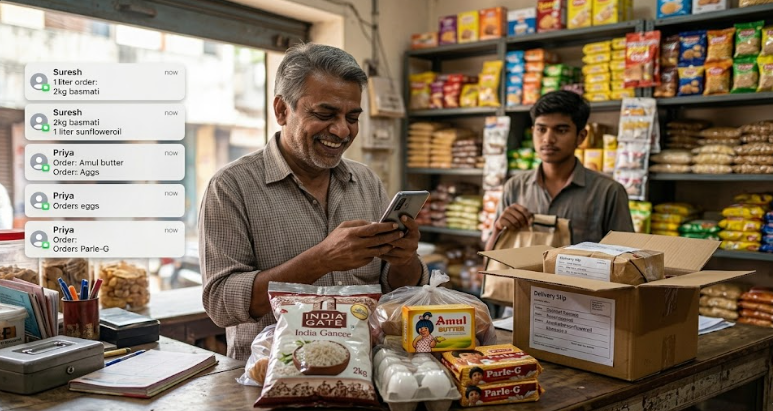
WhatsApp Business Marketing for Indian Shop Owners: Get More Orders Every Day (2026 Guide)
Learn how Indian shop owners use WhatsApp Business to send offers, take orders, and build customer loyalty — completely free.…